
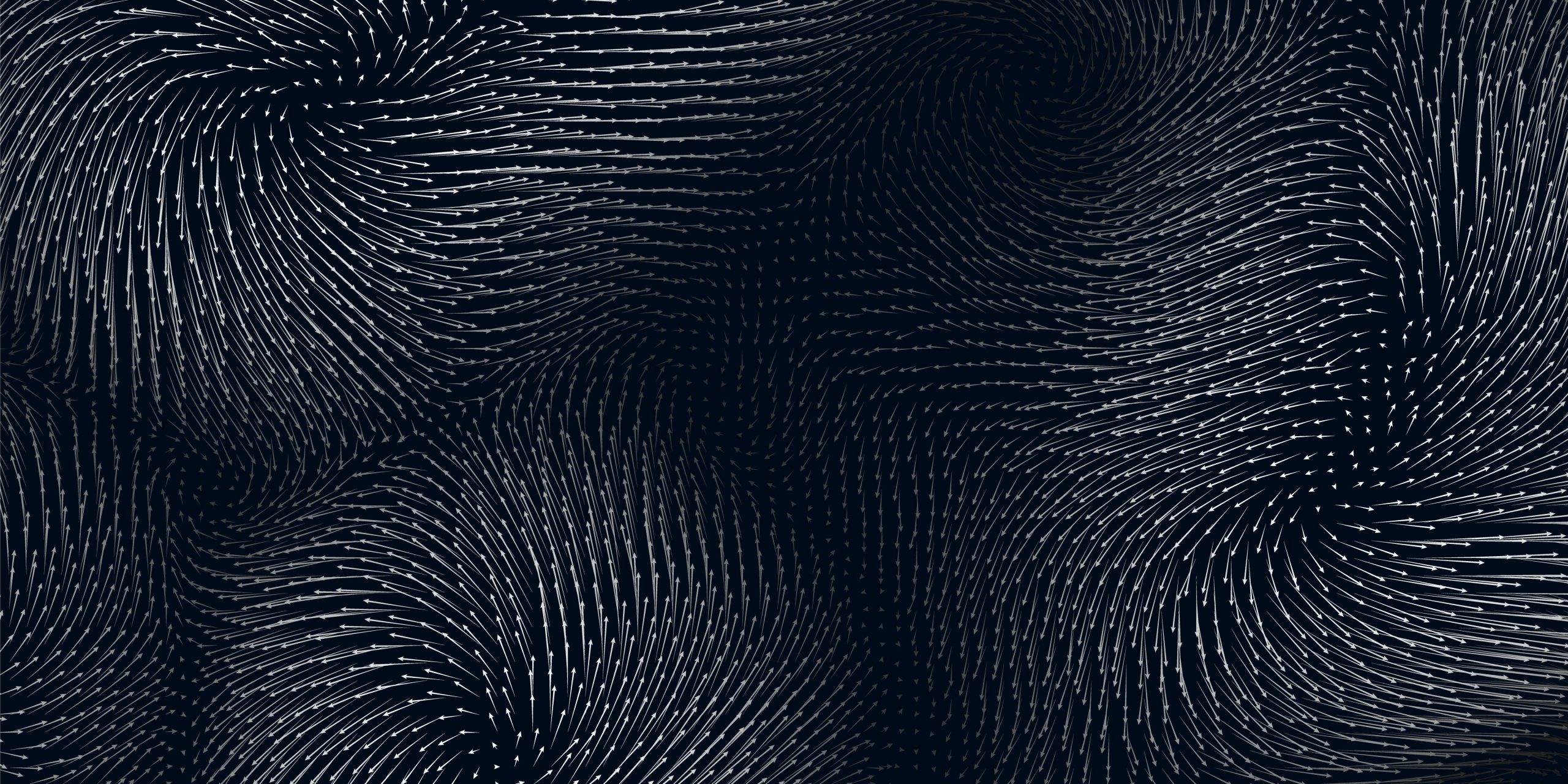
Learn About Magnetic Fields
Electrical charge is the intrinsic property of matter that produces positive or negative electric force. Magnetic fields are created by moving these electric charges, like electrons flowing through a wire. That flow is called the electric current. Every electron has a tiny magnetic field. When many electrons move together, those magnetic fields build upon each other to create a much stronger magnetic field. If that wire is wound into a coil that field becomes even stronger. The magnetic field extends radially from the center, with the field getting weaker as you move away from the wire.
Magnetic fields are represented visually with looping bands called magnetic field lines. The closer the lines are to each other, the stronger the magnetic field.
Magnetic fields also have directions that are represented with arrows. The direction of the magnetic field shows the path along which a magnetic force acts on a charged particle. The direction of the current establishes the direction of the field. The direction can be determined by using a mnemonic technique called the right-hand rule:
- Point your right thumb in the direction of the current
- Curl your fingers towards the palm of your hand.
- The direction your fingers are pointing indicates the direction the magnetic force would act on a particle.
This convention makes it easier to predict how magnetic fields will interact with other magnetic fields or moving charges. There are a few key behaviors that can happen when magnetic fields share the same space:
Opposite magnetic poles, North to south, result in an attractive force, Like magnetic poles, south to south, for example, will yield a repulsive force.
When a magnetic field changes near a conductor (such as a wire), it induces an electromotive force (EMF) which is the voltage or potential difference produced by a source and, subsequently, an electric current in the conductor.
Some materials can shield or redirect magnetic fields. For example, ferromagnetic materials can guide magnetic field lines through them, effectively redirecting the magnetic field.
If a magnetic dipole, like a bar magnet, is placed in an external magnetic field, it will experience a torque that aligns it with the external field. The torque is strongest when the dipole is perpendicular to the external field and zero when it is parallel.
Magnetic fields can be used to levitate objects when the force of the magnetic force is stronger than gravitational force.
Since the direction of the current determines the direction of the magnetic field, understanding the way the current is delivered is also important. There are two types of current:
AC (Alternating Current): AC refers to electric current that periodically reverses direction. In an AC system, the flow of electric charge regularly changes its direction, typically oscillating in a sine wave pattern. AC is commonly used for power distribution and in household electricity.
DC (Direct Current): DC is electric current that flows consistently in one direction. The flow of electric charge in a DC system remains constant over time. DC is often associated with batteries and is used in electronic devices where a steady and unidirectional flow of current is required.
Understanding the behavior of magnetic fields is crucial when trying to harness them for industrial applications.